Passages

Yesterday was my first day as the pastor at St. James Presbyterian Church, and this Sunday will be the first day I preach there in that capacity.

So I’ve been reflecting on the concept of passages, how we pass through to new places and new stages and even new ways of being throughout our lives.

In my sermon on Sunday, I’m pretty sure I’ll be speaking about liminality, and passing under the door lintel. These are two words that come from the Latin, limen, meaning threshold, or boundary.

At each new phase in our lives, we pass over a boundary, pass through a threshold, and it can be seriously disorienting. We may wonder who we are or who we might become. (There is a great wikipedia article about liminality that I enjoyed reading today.)

What is it that can support us, strengthen us, carry us through periods of liminality? I need to know there is something stable in the midst of the instability, the transition.

Spiritual practices that remind us of God’s presence are very helpful for me. When I give up the idea that everything rests on me, and I embrace the idea that everything rests on God and I only have to do the best I can with my little piece, then I breathe a sigh of relief. My pounding heart begins to slow it’s pace and my shoulders drop a couple of inches.

Here is a poem about water on the move. There’s a tradition of calling moving water “living water.” Isn’t that what Jesus promised to be for us? Living Water.

The narrator describes how nature is “unimpressed” by the burden he thinks he carries. My favorite line is about how the water “even made a little song out of all the things that got in its way.”

Now that’s perseverance without burden.

Passage                      by John Brehm

In all the woods that day I was
the only living thing
fretful, exhausted, or unsure.
Giant fir and spruce and cedar trees
that had stood their ground
three hundred years
stretched in sunlight calmly
unimpressed by whatever
it was that held me
hunched and tense above the stream,
biting my nails, calculating all
my impossibilities.
Nor did the water pause
to reflect or enter into
my considerations.
It found its way
over and around a crowd
of rocks in easy flourishes,
in laughing evasions and
shifts in direction.
Nothing could slow it down for long.
It even made a little song
out of all the things
that got in its way,
a music against the hard edges
of whatever might interrupt its going.

from Help is on the Way. © The University of Wisconsin Press, 2012.

God is Here, Now

A Prayer Among Friends
by John Daniel

Among other wonders of our lives, we are alive
with one another, we walk here
in the light of this unlikely world
that isn’t ours for long.

May we spend generously
the time we are given.
May we enact our responsibilities
as thoroughly as we enjoy
our pleasures. May we see with clarity,
may we seek a vision
that serves all beings, may we honor
the mystery surpassing our sight,
and may we hold in our hands
the dirt of good work
and bear it forth whole, as we
were borne forth by a power we praise
to this one Earth, this homeland of all we love.

This was our closing poem at Poetry Vespers last night. Our theme was “God is Here, Now,” and our scripture was Solomon’s prayer of dedication of the newly constructed temple in Jerusalem.

King Solomon prayed, “If heaven, even the highest heaven, can’t contain you, how can this temple that I’ve built contain you?”*

And the answer to that rhetorical question is, it can’t. The temple cannot contain God. Nor can a church, a community, or even a religion.

God is transcendent, greater than anything we can conceive, above and beyond all our human constructions. But God is also immanent, here, present, now, all around us. Solomon’s prayer reflects this understanding.

The idea of a transcendent and also immanent God invites us to look for God all around us, in our neighbors and neighborhoods, in the beauty and sometimes scary majesty of creation, in the laughter of our friends.

The building of the temple was a significant turning point in the communal and religious life of the Israelite people, just as Grace Commons settling into a new worship space at St. James is. At moments like this, its a good idea to stop and pray, as Solomon did.

Let’s remember and remind each other that the most important thing is relationship–how we are with each other, with our neighbors, and with God.

May we share and serve with generosity, knowing that God is with us, both inside the building and outside of it. God is with us, both in the times when things are going well, and also in the times when we are challenged or feel lost.

God may be present with us in the church building, but God is not contained or confined. God is here, now. And God is also “there.”

~ ~ ~

Bible translation from the Common English Bible, a new translation from the original Hebrew and Greek.

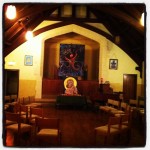
I took the picture after Vespers last night, and I regret that I didn’t think to take it while all the people were sitting there. In my own defense, though, I did have other things on my mind…like Poetry Vespers!

The good, the bad and the inconvenient

The good, the bad and the inconvenient

by Marge Piercy

Gardening is often a measured cruelty:
what is to live and what is to be torn
up by its roots and flung on the compost
to rot and give its essence to new soil.

It is not only the weeds I seize.
go down the row of new spinach—
their little bright Vs crowding—
and snatch every other, flinging

their little bodies just as healthy,
just as sound as their neighbors
but judged, by me, superfluous.
We all commit crimes too small

for us to measure, the ant soldiers
we stomp, whose only aim was to
protect, to feed their vast family.
It is I who decide which beetles

are “good” and which are “bad”
as if each is not whole in its kind.
We eat to live and so do they,
the locusts, the grasshoppers,

the flea beetles and aphids and slugs.
By bad I mean inconvenient. Nothing
we do is simple, without consequence
and each act is shadowed with death.

This was our opening poem at Poetry Vespers yesterday. Our scripture was Acts 4:32-5:11, the story of Ananias and Sapphira. Our theme for the evening was “The Burden To Be Ethical,” taking off from this line in the poem: “Nothing we do is simple, without consequence.”

A Note on Bible Study

From the bulletin at Grace Commons:

We study and discuss the bible a lot at Grace Commons, and we do it as a way to stay in touch with our roots, but also to develop our own theology and to reinterpret the old texts in ways relevant to contemporary situations and understandings.

The bible is a collection of stories preserved as a record of many peoples’ striving to know God and understand themselves in relation to the cosmos and the creation. It is filled with history, culture, poetry, metaphor, mystery, comedy and tragedy.

Our study of the bible should, like our spiritual practices, help us to become better people. When interpretations of the bible seem at odds with our ethics and commitments to grace, generosity, relationship and respect, we can, and should, set aside those interpretations and do what feels right.

We do all this not as renegade lone-rangers, but as a community rooted in mutuality, relationship, responsibility and hope for a commonwealth of people based in God’s dream of peace and wholeness for all of creation.

Image by Michael Coffey

Visual Prayer–Dear God, are you here?

These original photos were taken at Lake Michigan on my iPhone 4 through the instagram app. I tweeted them with words of prayer, and this is how I prayed that day.

I put the slides with words into a PowerPoint slideshow, then turned that into a Quicktime movie and uploaded it to YouTube.

In the slideshow, the words fade in and out with special timings which you don’t see in the movie. It’s a bit choppy here, but gives you a way to watch it without downloading the whole PowerPoint slideshow.

If you *do* want to download it, there are links below to two different sizes. The quality of the slideshows is much better than the YouTube video.

Below, you will find the words to the prayer, which I made up while looking through my camera lens. It’s really much, much better with the photos. They are the center of the prayer.

Visual Prayer by Nanette Sawyer-8MB pptx file

Visual Prayer, by Nanette Sawyer-53 MB pptx file

Dear God, are you here?

I am listening.

The way does not seem straight.

I am worn down by the waves.

I am trying to see the patterns.

Everything changes all the time.

I can’t go back the same way.

Can’t go back.

Some of it looks familiar.

The waters are rising up to my neck.

Come to the aid of your people, Holy One.

Foundations of old have passed away.

The footing is uncertain.

Bit by bit I have been worn away.

From where does my help come?

Never have you forsaken me.

Answer me when I call.

You are my strength, from morning ’til night.

Lead me, O God.

Make a way out of no way.

Listen to your people.

You are our strength and our redeemer.

With you at my side, how can I be afraid?

In and through all things you guide me.

Creation is so big, and we are so small.

But we are inside it.

All of us are.

All of us.

All of us.

You have heard the prayers of your people, O God.

May your steadfast love endure forever.

May your steadfast love endure forever.

May your steadfast love endure forever.

Amen and Amen and Amen.

Born of a Woman

Last year (2010) in the weeks leading up to Christmas, we did an art project at Wicker Park Grace during our Sunday Gatherings in which we transformed Christmas advertisements into a spiritual symbol. The idea was to disconnect from the excessive commercialism that Christmas has become, and reconnect to the underlying spiritual story of how the Divine came into human form through the birth of Jesus.

We got the idea from our friends at House for All Sinners and Saints and their pastor, Nadia Bolz-Weber, in Denver, CO. They did the project in 2008. They called their icon, Our Lady of the New Advent. They did theirs on poster board, but we wanted something more long lasting so we used a 1/2 inch thick art board and painted details on top of the collage.

I describe the project, tongue-in-cheek, as a paint-by-numbers Mary and Jesus project. The first week, with the background painted in green but Mary and Jesus blank white space, we thought it looked like an alien snowman from outer space. Each week we painted in a new color as background, and during the prayer time at our Spiritual Practice, people brought forward torn up bits of Christmas advertisements they brought from home, and glued them into the color-coded section.

Artist Monica J. Brown guided the project, and painted in the details, the faces and hands, at the end of the project, using an Ethiopian icon as a model for the features. Now this piece of art, collaboratively created, holds a central place in our gathering space on Sundays.

For pictures of the project all along the way, check out this set in flickr:
Theotokos icon project

Story Bread, connecting us

In case you missed our new video earlier this summer, here it is again. It’s just 4 minutes long, and gives a good sense of the spirit of Wicker Park Grace!

Towards the end of the video you’ll see me breaking bread and talking about the meaning of communion. That week I called the communion bread “story bread,” which I had never done before and haven’t done since. But I like the concept.

I say in the video that this bread is a physical bread and also a story bread, a bread which you encounter through the lens of your life and the lens of the bible. “And I hope and pray that it will give you nourishment and courage at a deep level.” And so I pray!

Special thanks to Brandon Sichling who made this video about Wicker Park Grace.

Psalms for Praying

This is one of my favorite books for prayer and liturgy. We use this book almost every week at Wicker Park Grace for our liturgical psalm.

We sing a refrain, taizé -style, sometimes an actual song from Taizé , and sometimes an original refrain composed to go with a particular psalm. In between the communally sung refrains, designated readers read the text of the psalm while our musicians improvise quietly in the background.

For example, from our gathering on Sept 11, we spoke these words from psalm 114:

Begin with REFRAIN:

Come all you who have wondered far from the path,
who have separated yourselves from Love;
A banquet has been prepared for you in the heart’s secret room.
There you will find the way Home; a welcome ever awaits you!
Even as you acknowledge the times you have erred,
The forgiveness of the Beloved will envelop you.

REFRAIN

Call upon the Beloved when fear arises, when you feel overwhelmed;
The eternal Listener will heed your cry;
You will find strength to face the shadows.
Befriend all that is within you, discover the Sacred Altar within your heart.
Then will abundant blessings enter your home;
And you will welcome the Divine Guest who is ever with you.
You are never alone!

REFRAIN

Restorative Justice

This is the sermon I preached on Sunday morning, Sept 11, 2011, at Lincoln Park Presbyterian Church. I gave a shorter version at Wicker Park Grace that evening.

Click the audio icon at the end of this post to listen in.

You can also right click here and “save link as” to download the mp3 file to your iTunes:

Restorative Justice download (mp3)

And here is a pdf transcript of what I said: Restorative Justice–Rev.Nanette.Sawyer

I approached the task of writing and preaching this sermon with fear and trembling. There is so much emotion surrounding 9/11 and all that has happened since, related to it.

Of course, the lectionary reading that came up was the Red Sea incident, in which the Israelite slaves cross over the sea to freedom, and their oppressors perish as the waters crash back down on them.

Is this a story about Justice, or about Liberation? Is it a story about Punishment, or about Salvation? Is there a difference?

What does “Justice” look like to God? I suggest that God’s justice is a Restorative Justice, and not a Retributive Justice.

One additional and important point I make is that we must think carefully about who “we are” in the story–are we the oppressed, or are we the oppressors? How does this story relate to our current world situation?

Listen in…


Communion Means Loving Across Barriers

I wrote about communion in the Wicker Park Grace e-newsletter this week. It’s so important that I want to repeat it here.

As a pastor, I have struggled with how to interpret communion and how to practice it in a community deeply committed to radical inclusion. In many times and places, communion has been interpreted as a boundary-marker between insiders and outsiders: those who are invited to eat the bread, and those who are not invited.

This is deeply ironic, given Jesus’s boundary-breaking meal practices for which he took so much flack. Insider/outside status was not a boundary that Jesus respected. He shared his table with anyone who would come and eat with him.

At the same time, I realize that the communion ritual has come to be an identity-marker for Christians. It’s something that Christians do. It’s a Christian practice. It ties us to a history, a lineage of people (some of whom we’d rather not be associated with, but that’s another story.)

How can we affirm, embrace, reclaim, reframe, the positive meanings of communion without reinforcing the negative ways it has been experienced? Unfortunately, the whole time we’re reclaiming and reframing, others continue to use communion as a marker of insider/outsider.

I can only hope that more and more communities will reframe and reclaim–that all of us will get better at articulating the intentional inclusivity of Jesus–in all that we do.

Here’s what I wrote in the e-notes:

Not everyone who participates at Wicker Park Grace
is a Christian, and we love that.
We are a community of learning, relationship, and hospitality.
At the same time, the spiritual practices we do
are Christian ones, and communion is a prime example.

We pass the bread from one to another
as a sign of how God moves among us,
and to experience serving one another.

We share communion often so that we can build up
memories and patterns and symbolic resonances.

Our communion table is open
to all who seek to be nourished by
the presence of God in this
communal meal practice begun by Jesus.

There are many signs of our unity in community and this ritual meal is only one of them. The Latin etymology of the word communion means “fellowship, mutual participation, a sharing.”

In that sense, our community meal that we share every week after our spiritual practice is another form of “communion.” Our conversations, our book groups, our dinners at one another’s homes, these are all ways we practice communion.

Eating the communion bread
is not a sign of our separation from
those who do not eat it.

Eating the communion bread
is a sign of our commitment to love,
as Jesus did, across all barriers.

So if you eat it, love, and be loved.
If you don’t eat it, love! And be loved!