Church for the 21st Century

Shawna's art notes-remix

Art notes by Shawna Bowman

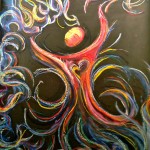
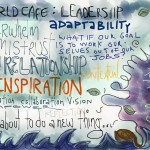
I just returned from a 3-day leadership consultation with the national offices of the Presbyterian Church (USA). My good friend and colleague, Rev. Shawna Bowman was there too. She wrote/drew the amazing notes above, while we were talking about new things that are happening or that we wish were happening in the churches.

The gathering left me very hopeful about the larger church beginning to shift into a more creative era which addresses and engages our contemporary age more effectively. I met many inspiring leaders who are trying new things and facing many of the same challenges faced by Grace Commons.

One new friend is Dawn Hyde, the pastor at Mission Bay Community Church. She wrote a nice overview reflection on our group time in Baltimore this week. You can read it here. In part, she said:

I am renewed in my belief that God is still working among us and that we now have better ideas for how we can share our resources (intellectual, financial, artistic, and physical) with one another. We dreamt together about PCUSA TED talks, Craigslist for the church, church partnerships, funded sabbaticals and rest, organic new ministries found and funded quickly. We reflected on how we are called to be open… to God, to each other, and to this new reality that we experience in the church. We worshiped together and gave life and breath to words of Isaiah 43 “Do not be afraid. I have called you by name you are mine… [PAY ATTENTION] I am doing a new thing.”

What I love is that it’s not just pastors and leaders in emerging or “presby-mergent” churches that are doing new things. Pastors in traditional churches of all sizes are trying to do new things, too.

So I hope we’ll be able to develop some ways to share our resources better and quicker and support each other’s dreams and creativity.

Art notes by Shawna Bowman

Art notes by Shawna Bowman

New Place, New Ministry, New Possibilities

Soon I will celebrate my 10-year anniversary of ordination. Unbelievable.

I have been serving Grace Commons and its predecessor, Wicker Park Grace, for ten years. Even as new possibilities open up, I will continue to serve as the pastor at Grace Commons–but things are changing!

Beginning November 1st, I will also become the half-time pastor at St. James Presbyterian Church in West Ridge (West Rogers Park), Chicago. On that day, my role with Grace Commons will also go from full-time to half-time.

I will be a full-time pastor, but for two communities simultaneously. Am I nervous? Yes. Am I excited? YES!

This will be a wonderful next step for me in my development as a pastor. I will explore and experiment with how to bring all that I have learned, discovered, and developed at Grace Commons, the art-gallery church, into a more traditional (albeit open, creative, and generous) church.

Grace Commons has been gathering for Spiritual Practice, our primary Sunday Gathering, at the St. James Church since September 9th, and we’ll keep on doing so. I believe that St. James will benefit from the vitality of Grace Commons, and Grace Commons will benefit from the stability of St. James. Both will maintain their own identities, but we are always changed when we make new friends–and I hope this will be no exception to that rule.

By “sharing” a pastor, these two communities are both taking a step toward a more relational, collaborative, connectional style of ministry. Each community has much to offer the other, and much to gain.

Gathering in West Ridge, quite a bit further north than our original location in Wicker Park, creates new challenges and new opportunities for Grace Commons. We know that many of our far south-siders, who could make the trek to Wicker Park, will not make the long commute to West Ridge every week. That’s the challenge.

The opportunity is this: we’re expanding our ministry to include a partnership with the Hesed Community Co-operative in the Little Village/Douglas Park area.

On the first and third Sunday’s of the month, simultaneous to Grace Commons gathering at St. James, some of us will gather at Hesed Community at 5:30 pm for a shared meal, spiritual practice, and creative, original communion liturgy that we are developing for this purpose. (We’re grateful to St. Lydia’s Dinner Church in NYC for their inspiration!)

On the second and fourth Sundays, we’ll all gather together at St. James. Our intention is that we’ll continue to grow and develop in both locations, but keep coming together as a whole community at least twice a month at St. James.

Just to be clear, Grace Commons will be gathering at St. James every single week at 5:30 pm. We want that stability and constancy, even while developing the secondary gathering at Hesed Community Co-op on the 1st and 3rd Sundays.

The St. James community also gathers for worship, and I will be leading that with the community and a wonderful lead musician, at 10:30 on Sunday mornings. This is yet to be developed, but I know it will be interesting and beautiful in its own way.

There’s much more to tell, of course. This is the beginning of a growing dream, and as one person recently said, “we’re sailing this boat while we build it.” So we don’t know what all will happen. I guess we never do anyway! But we are sailing forward with dreams and possibilities–and with each other–as our circles of relationship and spheres of influence continue to grow.

Visual Prayer–Dear God, are you here?

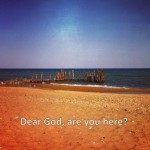
These original photos were taken at Lake Michigan on my iPhone 4 through the instagram app. I tweeted them with words of prayer, and this is how I prayed that day.

I put the slides with words into a PowerPoint slideshow, then turned that into a Quicktime movie and uploaded it to YouTube.

In the slideshow, the words fade in and out with special timings which you don’t see in the movie. It’s a bit choppy here, but gives you a way to watch it without downloading the whole PowerPoint slideshow.

If you *do* want to download it, there are links below to two different sizes. The quality of the slideshows is much better than the YouTube video.

Below, you will find the words to the prayer, which I made up while looking through my camera lens. It’s really much, much better with the photos. They are the center of the prayer.

Visual Prayer by Nanette Sawyer-8MB pptx file

Visual Prayer, by Nanette Sawyer-53 MB pptx file

Dear God, are you here?

I am listening.

The way does not seem straight.

I am worn down by the waves.

I am trying to see the patterns.

Everything changes all the time.

I can’t go back the same way.

Can’t go back.

Some of it looks familiar.

The waters are rising up to my neck.

Come to the aid of your people, Holy One.

Foundations of old have passed away.

The footing is uncertain.

Bit by bit I have been worn away.

From where does my help come?

Never have you forsaken me.

Answer me when I call.

You are my strength, from morning ’til night.

Lead me, O God.

Make a way out of no way.

Listen to your people.

You are our strength and our redeemer.

With you at my side, how can I be afraid?

In and through all things you guide me.

Creation is so big, and we are so small.

But we are inside it.

All of us are.

All of us.

All of us.

You have heard the prayers of your people, O God.

May your steadfast love endure forever.

May your steadfast love endure forever.

May your steadfast love endure forever.

Amen and Amen and Amen.

My Lunch with John Cobb

John B. Cobb

I just happened to be in the right place at the right time. Well, and I was brave. I was attending the Emergent Village Theological Conversation a few weeks ago and just loving the conversation about Process Theology.

On several occasions I was hovering around waiting for a chance to talk to John Cobb, a well-known process theologian who has now been retired for 20 years. I wanted to thank him for his thought-provoking presentations and to ask him a question or two.

But of course many people wanted to do the same thing. I gave up several times, told myself it wasn’t important, walked away and circled back, hung around while someone else video-taped him, then had my opportunity.

After thanking him for his presentations I said that I would love to ask him a few questions at some point. (That was the brave part.) He said, “How about now? I’m about to have some lunch.” I felt like the luckiest person in the world.

That meal was like sitting down for a lunch-time chat with Jimmy Carter about world politics. Let’s just say, John Cobb has thought through a few issues. I came away from that lunch with a great deal of admiration for him as a thinker and tremendous respect for him as a kind and generous human being.

The thing that was most moving and helpful for me, though, was the depth of his Christian faith. He spoke with conviction about the importance of Christ, even while he described an openness to learning about God through the insights of non-Christians. Dr. Cobb affirmed certain core convictions of Christianity, but reframed them in such a way that I felt liberated.

It was as though he was pointing to a window looking out onto a landscape I had never seen. What process theology has given him, he said, is a language with which to speak about God and Christ which doesn’t require him to hand over his rationality. And yet, his “rationality” is not limited by old categories.

Everything he spoke of, he presented with humility, acknowledging the imperfection of his knowing, but never hesitating to seek a greater understanding of God. He said that all of us who speak about God are merely speculating, but he believes that we are called to speculate!

After lunch, as I listened to more presentations and began reading his books, I saw that all my questions have been asked many times before. I was right on track with the questions so many people have.

I asked some big questions like: How do you understand the incarnation? How was God present in Jesus? How does what Jesus did then relate to us now? To answer them, he always began by reframing the question and undoing my entire (unconscious) metaphysics. What is the world made of? What is existence? What makes a human being?

I won’t be able to even list all the questions here, but I highly recommend that you check out Dr. Cobb’s comments in his “Ask Dr. Cobb” column over at the Process and Faith website.

Right now I am reading The Process Perspective II. (It’s okay to skip the first one and go right to this one, which is also available digitally.) It gives a simple introduction to Christian process theology and covers basic metaphysics, the nature of God, science, evolution and ecology, the nature of Christ, the problem of evil, and religious pluralism. These are collections of pieces from the “Ask Dr. Cobb” column. He is so conversational in his answers that reading them feels like sitting down for lunch with him.

I only wish I had some of that great bok choy and rice we had that day in early February.

Joy ~ Consenting to Worthiness

This is the third week of Advent, and at Grace Commons we have a tradition of honoring Mary on this week. In the past we’ve used the theme of Courage and Action, contemplating how much courage it takes sometimes to move into action.

Mary, the mother of God, is such a great, courageous example for us. She steps into her destiny. That’s so courageous. She agrees to do something that won’t be easy or simple–but it’s right for her. She has the capacity to temporarily contain the uncontainable; to hold divinity within her body. And she chooses to do so!

This year we are using the more traditional weekly themes of Hope, Love, Joy (and next week, Peace.)

I’m thinking about the kind of steady, deep (different from cheery) joy that a person has when they are doing what they are meant to do–when they feel they are being useful in the world, and using their gifts well.

The Annunciation is the announcement of the angel telling Mary what is about to happen to her through her pregnancy. It seems it would be easier if God would announce as clearly what is to happen to each of us, but we are left to discern it, to seek out our vocations, our callings, our purposes, and our capacities.

Annunciation by Denise Levertov is one of my all-time favorite poems. You can read the full poem here.  Here’s a part of it:

Aren’t there annunciations
of one sort or another
in most lives?
Some unwillingly
undertake great destinies,
enact them in sullen pride,
uncomprehending.
More often
those moments
when roads of light and storm
open from darkness in a man or woman,
are turned away from
in dread, in a wave of weakness, in despair
and with relief.
Ordinary lives continue.
God does not smite them.
But the gates close, the pathway vanishes.

“Aren’t there annunciations of one sort or another in most lives?” We have that moment when we’re confronted with the opportunity to be authentic, to believe in ourselves, to tell the truth, to take a risk for love or justice, to do something for the ones who are looking to us, relying on us to use our gifts and skills and be strong, beautiful, compassionate, steady, protective, creative.

Some moments of potential we walk into. Other times we let the gates of possibility close because of our dread, our weakness, our despair. In those moments, not only does God not smite us, but God also does not abandon us. There is always a path before us, always a next step to take, and always God is near us, God-with-us, hoping we will have the courage to let go of our own sense of unworthiness.

It’s easy to think of the Virgin Mary as demure, as quiet and obedient, submissive–it’s easy, because we’ve been trained to think that way, about Mary, about the ideal woman, or the ideal Christian. Submit, obey, demure, sacrifice, deny yourself.

But I think Mary’s example and the teaching she offers us is exactly the opposite of that. To fulfill her destiny, she had to step into herself, embody herself, and realize her own capacity. By joining herself with God, she had the capacity to carry God within her and bring God into the world.

She did not cry, “I cannot, I am not worthy,”
nor “I have not the strength.”
She did not submit with gritted teeth,
raging, coerced.
Bravest of all humans,
consent illumined her.
The room filled with its light,
the lily glowed in it,
and the iridescent wings.
Consent,
courage unparalleled,
opened her utterly.

She was worthy. She was worthy to meet the task that was put before her. And so are you, and so am I.

Mary did not submit, but she gave consent. Think about the difference between those two words. To submit to coercion, or to consent to possibility. I love the idea that consent illumined her.

But to what was she consenting? What I love about this poem is that Mary consents to her own worthiness. She was worthy of being loved by God, “favored” the biblical text says. And I believe that God favors each and every one of us.

This is God’s omni-partiality (a word I got from Process Theologians); being partial to, or loving intensely and distinctly, every being. God waits for us to realize that God loves us. God waits for our consent to our own worthiness before we can be filled with luminosity.

But when we do consent to that worthiness, we are strengthened with courage. And, I would suggest, we open ourselves to the possibility of a deep and abiding joy.

~ ~ ~ ~ ~ ~ ~ ~ ~ ~ ~ ~ ~ ~ ~ ~ ~ ~ ~ ~

The image of the Spanish Our Lady of Guadalupe in Loboc, the Philippines, is from http://en.wikipedia.org/wiki/File:La_Guadalupana_Loboquena.jpg

Wordle!

What fun! This week I was introduced to a new website: wordle.net.

Just type in words, or paste in large amounts of text, and “create.” The larger the word, the more times it appeared in your text.

This wordle is based on a combination of words people wrote down during the Taize Vespers gathering on Sunday, a recent community retreat, and the most recent Community Life essays on Wicker Park Grace/Grace Commons’ website.

This is a word picture of my faith community.


A Network of Friends Seeking Transformation

I’m always amazed when I watch this video, by the huge amount of similarity we use in talking about our emerging efforts at being church in new ways.

Created in the spring of 2010 at a gathering in Minneapolis, this video features 16 really cool people doing awesome things across the country.

Each of us speaks for less than a minute in this 10-minute video, but the editor has interspersed our comments so that you easily hear the similarities (and differences) in what we’re doing.

I hear similarities of hospitality, having a posture of openness, taking the risk to fail and sometimes failing, being on a journey with people, really loving people sincerely, living a faith-kind-of-life, developing strong spiritual practices, claiming and interpreting the bible, putting ourselves into the stories, welcoming diversity, not using “church” words, dealing with conflict, being creative or not being creative, being changed by the people who show up; in other words, seeking to be transformed.

I wish I knew all these people better than I do, but I at least know them all a little bit!

The video was produced by Steve Knight, who founded The Transform Network, filmed by Wes Halula, and edited by Don Heatley.

Born of a Woman

Last year (2010) in the weeks leading up to Christmas, we did an art project at Wicker Park Grace during our Sunday Gatherings in which we transformed Christmas advertisements into a spiritual symbol. The idea was to disconnect from the excessive commercialism that Christmas has become, and reconnect to the underlying spiritual story of how the Divine came into human form through the birth of Jesus.

We got the idea from our friends at House for All Sinners and Saints and their pastor, Nadia Bolz-Weber, in Denver, CO. They did the project in 2008. They called their icon, Our Lady of the New Advent. They did theirs on poster board, but we wanted something more long lasting so we used a 1/2 inch thick art board and painted details on top of the collage.

I describe the project, tongue-in-cheek, as a paint-by-numbers Mary and Jesus project. The first week, with the background painted in green but Mary and Jesus blank white space, we thought it looked like an alien snowman from outer space. Each week we painted in a new color as background, and during the prayer time at our Spiritual Practice, people brought forward torn up bits of Christmas advertisements they brought from home, and glued them into the color-coded section.

Artist Monica J. Brown guided the project, and painted in the details, the faces and hands, at the end of the project, using an Ethiopian icon as a model for the features. Now this piece of art, collaboratively created, holds a central place in our gathering space on Sundays.

For pictures of the project all along the way, check out this set in flickr:
Theotokos icon project

Story Bread, connecting us

In case you missed our new video earlier this summer, here it is again. It’s just 4 minutes long, and gives a good sense of the spirit of Wicker Park Grace!

Towards the end of the video you’ll see me breaking bread and talking about the meaning of communion. That week I called the communion bread “story bread,” which I had never done before and haven’t done since. But I like the concept.

I say in the video that this bread is a physical bread and also a story bread, a bread which you encounter through the lens of your life and the lens of the bible. “And I hope and pray that it will give you nourishment and courage at a deep level.” And so I pray!

Special thanks to Brandon Sichling who made this video about Wicker Park Grace.

Missional + Faith + Community

Aion Tea House, Wicker Park, 2004

Wicker Park Grace was started with grants from the Presbyterian Church (USA) as a “new church development (NCD).” Seven years of annually smaller and smaller grants end this year. The initial idea was to start a church in a new way, maybe a “church without walls.” Something that would be more resonant with millennial people. Something that would draw from the roots of tradition and history, but which would continue to grow and develop new branches, new blossoms.

After 2 years meeting in coffee shops, and 6 years meeting in an art gallery, Wicker Park Grace has been rootless and wandering for 6 months, having lost our art gallery to an expanding company, building more offices. We’ve been meeting in the common rooms and fellowship halls of two different churches in two different neighborhoods. Who are we? What are we becoming? We’re no longer a “new church development,” but institutionalizing as a church does not seem like the right move for us because of the ways the structure would change and limit us.

We looked to our friends at Broad Street Ministries in Philadelphia for a new model. They came to the same turning point where WPG finds ourselves. Broadstreet serves a transient, urban population and was committed to not having membership roles. We are similarly committed. When someone shows up and participates, they’re “in.” Our friends down at the Emmaus Community in Chicago Heights talk about “belonging before believing.”

They say, “At Emmaus you can belong before you believe. You do not have to be a member to share your gifts, talents, or abilities. This church celebrates the sacraments of communion and baptism and takes the Bible seriously.” Lots of people and lots of faith communities are having these kinds of conversations.

The Presbytery of Chicago is in process of adopting a new policy manual for new church developments, and it will have a section describing the option for a community to affiliate with the Presbytery as either a new church, or as a “Missional Faith Community.” Here’s how the policy reads, in part.

A Missional Faith Community:

exists to love, serve, challenge, pray and struggle alongside the surrounding community where it finds itself called into being by God

engages a theology that is compatible with the Reformed Tradition

gathers regularly for worship, for opportunities to explore Christian discipleship and spiritual formation and to follow Jesus Christ

has a plan for spiritual and worship leadership that is appropriately equipped for leadership and faithfully compensated

has an identifiable and recognized lay leadership and a faithful and accountable governance structure

has an ongoing commitment to mission planning and to communicating a vision for ministry that may include leadership training, growth, evangelism, and a commitment to engagement with the community in which it serves

has a realistic financial plan for sustaining its ministry

Lots of this language is from Broad Street Ministries, and the Missional Guidelines from the Presbytery of Philadelphia. We’re grateful to them for documenting their work there in the Philadelphia Presbytery. And we’re grateful for the wonderful work they do in downtown Philadelphia!

We think that Wicker Park Grace will appeal to the Presbytery of Chicago in November to become the first Missional Faith Community of the presbytery. The leadership co-op of Wicker Park Grace is planning a community retreat to explore this together in October.