Church for the 21st Century

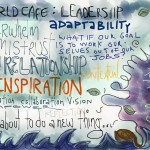
Shawna's art notes-remix

Art notes by Shawna Bowman

I just returned from a 3-day leadership consultation with the national offices of the Presbyterian Church (USA). My good friend and colleague, Rev. Shawna Bowman was there too. She wrote/drew the amazing notes above, while we were talking about new things that are happening or that we wish were happening in the churches.

The gathering left me very hopeful about the larger church beginning to shift into a more creative era which addresses and engages our contemporary age more effectively. I met many inspiring leaders who are trying new things and facing many of the same challenges faced by Grace Commons.

One new friend is Dawn Hyde, the pastor at Mission Bay Community Church. She wrote a nice overview reflection on our group time in Baltimore this week. You can read it here. In part, she said:

I am renewed in my belief that God is still working among us and that we now have better ideas for how we can share our resources (intellectual, financial, artistic, and physical) with one another. We dreamt together about PCUSA TED talks, Craigslist for the church, church partnerships, funded sabbaticals and rest, organic new ministries found and funded quickly. We reflected on how we are called to be open… to God, to each other, and to this new reality that we experience in the church. We worshiped together and gave life and breath to words of Isaiah 43 “Do not be afraid. I have called you by name you are mine… [PAY ATTENTION] I am doing a new thing.”

What I love is that it’s not just pastors and leaders in emerging or “presby-mergent” churches that are doing new things. Pastors in traditional churches of all sizes are trying to do new things, too.

So I hope we’ll be able to develop some ways to share our resources better and quicker and support each other’s dreams and creativity.

Art notes by Shawna Bowman

Art notes by Shawna Bowman

God is Here, Now

A Prayer Among Friends
by John Daniel

Among other wonders of our lives, we are alive
with one another, we walk here
in the light of this unlikely world
that isn’t ours for long.

May we spend generously
the time we are given.
May we enact our responsibilities
as thoroughly as we enjoy
our pleasures. May we see with clarity,
may we seek a vision
that serves all beings, may we honor
the mystery surpassing our sight,
and may we hold in our hands
the dirt of good work
and bear it forth whole, as we
were borne forth by a power we praise
to this one Earth, this homeland of all we love.

This was our closing poem at Poetry Vespers last night. Our theme was “God is Here, Now,” and our scripture was Solomon’s prayer of dedication of the newly constructed temple in Jerusalem.

King Solomon prayed, “If heaven, even the highest heaven, can’t contain you, how can this temple that I’ve built contain you?”*

And the answer to that rhetorical question is, it can’t. The temple cannot contain God. Nor can a church, a community, or even a religion.

God is transcendent, greater than anything we can conceive, above and beyond all our human constructions. But God is also immanent, here, present, now, all around us. Solomon’s prayer reflects this understanding.

The idea of a transcendent and also immanent God invites us to look for God all around us, in our neighbors and neighborhoods, in the beauty and sometimes scary majesty of creation, in the laughter of our friends.

The building of the temple was a significant turning point in the communal and religious life of the Israelite people, just as Grace Commons settling into a new worship space at St. James is. At moments like this, its a good idea to stop and pray, as Solomon did.

Let’s remember and remind each other that the most important thing is relationship–how we are with each other, with our neighbors, and with God.

May we share and serve with generosity, knowing that God is with us, both inside the building and outside of it. God is with us, both in the times when things are going well, and also in the times when we are challenged or feel lost.

God may be present with us in the church building, but God is not contained or confined. God is here, now. And God is also “there.”

~ ~ ~

Bible translation from the Common English Bible, a new translation from the original Hebrew and Greek.

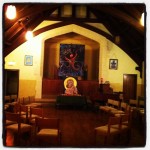
I took the picture after Vespers last night, and I regret that I didn’t think to take it while all the people were sitting there. In my own defense, though, I did have other things on my mind…like Poetry Vespers!

New Place, New Ministry, New Possibilities

Soon I will celebrate my 10-year anniversary of ordination. Unbelievable.

I have been serving Grace Commons and its predecessor, Wicker Park Grace, for ten years. Even as new possibilities open up, I will continue to serve as the pastor at Grace Commons–but things are changing!

Beginning November 1st, I will also become the half-time pastor at St. James Presbyterian Church in West Ridge (West Rogers Park), Chicago. On that day, my role with Grace Commons will also go from full-time to half-time.

I will be a full-time pastor, but for two communities simultaneously. Am I nervous? Yes. Am I excited? YES!

This will be a wonderful next step for me in my development as a pastor. I will explore and experiment with how to bring all that I have learned, discovered, and developed at Grace Commons, the art-gallery church, into a more traditional (albeit open, creative, and generous) church.

Grace Commons has been gathering for Spiritual Practice, our primary Sunday Gathering, at the St. James Church since September 9th, and we’ll keep on doing so. I believe that St. James will benefit from the vitality of Grace Commons, and Grace Commons will benefit from the stability of St. James. Both will maintain their own identities, but we are always changed when we make new friends–and I hope this will be no exception to that rule.

By “sharing” a pastor, these two communities are both taking a step toward a more relational, collaborative, connectional style of ministry. Each community has much to offer the other, and much to gain.

Gathering in West Ridge, quite a bit further north than our original location in Wicker Park, creates new challenges and new opportunities for Grace Commons. We know that many of our far south-siders, who could make the trek to Wicker Park, will not make the long commute to West Ridge every week. That’s the challenge.

The opportunity is this: we’re expanding our ministry to include a partnership with the Hesed Community Co-operative in the Little Village/Douglas Park area.

On the first and third Sunday’s of the month, simultaneous to Grace Commons gathering at St. James, some of us will gather at Hesed Community at 5:30 pm for a shared meal, spiritual practice, and creative, original communion liturgy that we are developing for this purpose. (We’re grateful to St. Lydia’s Dinner Church in NYC for their inspiration!)

On the second and fourth Sundays, we’ll all gather together at St. James. Our intention is that we’ll continue to grow and develop in both locations, but keep coming together as a whole community at least twice a month at St. James.

Just to be clear, Grace Commons will be gathering at St. James every single week at 5:30 pm. We want that stability and constancy, even while developing the secondary gathering at Hesed Community Co-op on the 1st and 3rd Sundays.

The St. James community also gathers for worship, and I will be leading that with the community and a wonderful lead musician, at 10:30 on Sunday mornings. This is yet to be developed, but I know it will be interesting and beautiful in its own way.

There’s much more to tell, of course. This is the beginning of a growing dream, and as one person recently said, “we’re sailing this boat while we build it.” So we don’t know what all will happen. I guess we never do anyway! But we are sailing forward with dreams and possibilities–and with each other–as our circles of relationship and spheres of influence continue to grow.

Love your enemies: an illuminated reading

One of the techniques we’ve developed at Grace Commons is to read a scripture while inserting commentary as you go.

People have told me that this is similar to expository preaching, although I’ve never learned about that specifically.

I find that many people are hungry to better understand biblical stories, and definitely want to un-do the damage done by bad application of biblical texts.

In a nutshell, in this 15 minute sermon, which I preached in February 2011, I explain how the cultural context in Jesus’s day is vitally important in our interpretation of the “Love your enemies” story.

(Oh, and I should say, I preached this as a guest preacher in a traditional church. At Grace Commons I don’t preach like this in a robe and from a pulpit. I sit with the people and wear regular clothes.)

This “love your enemies” bit is part of Jesus’s sermon on the mount and I believe it is a call to dignity for all human beings.

In this sermon I also reflect on the idea that God is “omni-partial” to all creatures and all of creation…an idea I got (and like!) from process theology.

The bible should never be used as a weapon, and if our interpretations of the text lead us to act in ways which are unkind or ungenerous, we should question our interpretation.

Specifically, regarding this admonition, “love your enemies,” Jesus is not calling us to allow people to disrespect us. Jesus is calling us to act with dignity and strive to treat all human beings with dignity.

Visual Prayer–Dear God, are you here?

These original photos were taken at Lake Michigan on my iPhone 4 through the instagram app. I tweeted them with words of prayer, and this is how I prayed that day.

I put the slides with words into a PowerPoint slideshow, then turned that into a Quicktime movie and uploaded it to YouTube.

In the slideshow, the words fade in and out with special timings which you don’t see in the movie. It’s a bit choppy here, but gives you a way to watch it without downloading the whole PowerPoint slideshow.

If you *do* want to download it, there are links below to two different sizes. The quality of the slideshows is much better than the YouTube video.

Below, you will find the words to the prayer, which I made up while looking through my camera lens. It’s really much, much better with the photos. They are the center of the prayer.

Visual Prayer by Nanette Sawyer-8MB pptx file

Visual Prayer, by Nanette Sawyer-53 MB pptx file

Dear God, are you here?

I am listening.

The way does not seem straight.

I am worn down by the waves.

I am trying to see the patterns.

Everything changes all the time.

I can’t go back the same way.

Can’t go back.

Some of it looks familiar.

The waters are rising up to my neck.

Come to the aid of your people, Holy One.

Foundations of old have passed away.

The footing is uncertain.

Bit by bit I have been worn away.

From where does my help come?

Never have you forsaken me.

Answer me when I call.

You are my strength, from morning ’til night.

Lead me, O God.

Make a way out of no way.

Listen to your people.

You are our strength and our redeemer.

With you at my side, how can I be afraid?

In and through all things you guide me.

Creation is so big, and we are so small.

But we are inside it.

All of us are.

All of us.

All of us.

You have heard the prayers of your people, O God.

May your steadfast love endure forever.

May your steadfast love endure forever.

May your steadfast love endure forever.

Amen and Amen and Amen.

Joy ~ Consenting to Worthiness

This is the third week of Advent, and at Grace Commons we have a tradition of honoring Mary on this week. In the past we’ve used the theme of Courage and Action, contemplating how much courage it takes sometimes to move into action.

Mary, the mother of God, is such a great, courageous example for us. She steps into her destiny. That’s so courageous. She agrees to do something that won’t be easy or simple–but it’s right for her. She has the capacity to temporarily contain the uncontainable; to hold divinity within her body. And she chooses to do so!

This year we are using the more traditional weekly themes of Hope, Love, Joy (and next week, Peace.)

I’m thinking about the kind of steady, deep (different from cheery) joy that a person has when they are doing what they are meant to do–when they feel they are being useful in the world, and using their gifts well.

The Annunciation is the announcement of the angel telling Mary what is about to happen to her through her pregnancy. It seems it would be easier if God would announce as clearly what is to happen to each of us, but we are left to discern it, to seek out our vocations, our callings, our purposes, and our capacities.

Annunciation by Denise Levertov is one of my all-time favorite poems. You can read the full poem here.  Here’s a part of it:

Aren’t there annunciations
of one sort or another
in most lives?
Some unwillingly
undertake great destinies,
enact them in sullen pride,
uncomprehending.
More often
those moments
when roads of light and storm
open from darkness in a man or woman,
are turned away from
in dread, in a wave of weakness, in despair
and with relief.
Ordinary lives continue.
God does not smite them.
But the gates close, the pathway vanishes.

“Aren’t there annunciations of one sort or another in most lives?” We have that moment when we’re confronted with the opportunity to be authentic, to believe in ourselves, to tell the truth, to take a risk for love or justice, to do something for the ones who are looking to us, relying on us to use our gifts and skills and be strong, beautiful, compassionate, steady, protective, creative.

Some moments of potential we walk into. Other times we let the gates of possibility close because of our dread, our weakness, our despair. In those moments, not only does God not smite us, but God also does not abandon us. There is always a path before us, always a next step to take, and always God is near us, God-with-us, hoping we will have the courage to let go of our own sense of unworthiness.

It’s easy to think of the Virgin Mary as demure, as quiet and obedient, submissive–it’s easy, because we’ve been trained to think that way, about Mary, about the ideal woman, or the ideal Christian. Submit, obey, demure, sacrifice, deny yourself.

But I think Mary’s example and the teaching she offers us is exactly the opposite of that. To fulfill her destiny, she had to step into herself, embody herself, and realize her own capacity. By joining herself with God, she had the capacity to carry God within her and bring God into the world.

She did not cry, “I cannot, I am not worthy,”
nor “I have not the strength.”
She did not submit with gritted teeth,
raging, coerced.
Bravest of all humans,
consent illumined her.
The room filled with its light,
the lily glowed in it,
and the iridescent wings.
Consent,
courage unparalleled,
opened her utterly.

She was worthy. She was worthy to meet the task that was put before her. And so are you, and so am I.

Mary did not submit, but she gave consent. Think about the difference between those two words. To submit to coercion, or to consent to possibility. I love the idea that consent illumined her.

But to what was she consenting? What I love about this poem is that Mary consents to her own worthiness. She was worthy of being loved by God, “favored” the biblical text says. And I believe that God favors each and every one of us.

This is God’s omni-partiality (a word I got from Process Theologians); being partial to, or loving intensely and distinctly, every being. God waits for us to realize that God loves us. God waits for our consent to our own worthiness before we can be filled with luminosity.

But when we do consent to that worthiness, we are strengthened with courage. And, I would suggest, we open ourselves to the possibility of a deep and abiding joy.

~ ~ ~ ~ ~ ~ ~ ~ ~ ~ ~ ~ ~ ~ ~ ~ ~ ~ ~ ~

The image of the Spanish Our Lady of Guadalupe in Loboc, the Philippines, is from http://en.wikipedia.org/wiki/File:La_Guadalupana_Loboquena.jpg

Wordle!

What fun! This week I was introduced to a new website: wordle.net.

Just type in words, or paste in large amounts of text, and “create.” The larger the word, the more times it appeared in your text.

This wordle is based on a combination of words people wrote down during the Taize Vespers gathering on Sunday, a recent community retreat, and the most recent Community Life essays on Wicker Park Grace/Grace Commons’ website.

This is a word picture of my faith community.


Graceful Living: Faith, Values, and Money

In November I’m blogging this book by Laura Dunham, Graceful Living: Your Faith, Values, and Money in Changing Times. Laura is a Presbyterian minister, a certified financial planner, and a former college professor.

We’re taking a look at Stewardship at Wicker Park Grace, and how our relationship with money affects our relationships with the world and each other.

How is money a spiritual thing? How can getting our finances in order make us stronger spiritually?

Mostly I’ll focus on Part One in the book: Choosing How to Live.

Chapter One: Living in a Consumer Society

Chapter Two: Money as a Spiritual Concern

Chapter Three: Graceful Living: Designing a Lifestyle Consistent with Your Faith

I got a copy of this book from a Stewardship group at the Presbytery of Chicago, and unfortunately, I can’t find where it’s easily available on-line. If anybody knows, please post a comment here!

Communion Means Loving Across Barriers

I wrote about communion in the Wicker Park Grace e-newsletter this week. It’s so important that I want to repeat it here.

As a pastor, I have struggled with how to interpret communion and how to practice it in a community deeply committed to radical inclusion. In many times and places, communion has been interpreted as a boundary-marker between insiders and outsiders: those who are invited to eat the bread, and those who are not invited.

This is deeply ironic, given Jesus’s boundary-breaking meal practices for which he took so much flack. Insider/outside status was not a boundary that Jesus respected. He shared his table with anyone who would come and eat with him.

At the same time, I realize that the communion ritual has come to be an identity-marker for Christians. It’s something that Christians do. It’s a Christian practice. It ties us to a history, a lineage of people (some of whom we’d rather not be associated with, but that’s another story.)

How can we affirm, embrace, reclaim, reframe, the positive meanings of communion without reinforcing the negative ways it has been experienced? Unfortunately, the whole time we’re reclaiming and reframing, others continue to use communion as a marker of insider/outsider.

I can only hope that more and more communities will reframe and reclaim–that all of us will get better at articulating the intentional inclusivity of Jesus–in all that we do.

Here’s what I wrote in the e-notes:

Not everyone who participates at Wicker Park Grace
is a Christian, and we love that.
We are a community of learning, relationship, and hospitality.
At the same time, the spiritual practices we do
are Christian ones, and communion is a prime example.

We pass the bread from one to another
as a sign of how God moves among us,
and to experience serving one another.

We share communion often so that we can build up
memories and patterns and symbolic resonances.

Our communion table is open
to all who seek to be nourished by
the presence of God in this
communal meal practice begun by Jesus.

There are many signs of our unity in community and this ritual meal is only one of them. The Latin etymology of the word communion means “fellowship, mutual participation, a sharing.”

In that sense, our community meal that we share every week after our spiritual practice is another form of “communion.” Our conversations, our book groups, our dinners at one another’s homes, these are all ways we practice communion.

Eating the communion bread
is not a sign of our separation from
those who do not eat it.

Eating the communion bread
is a sign of our commitment to love,
as Jesus did, across all barriers.

So if you eat it, love, and be loved.
If you don’t eat it, love! And be loved!

Disarming the Clobber Passages, #3

In the final discussion of the movie Fish Out of Water, we moved on the three new testament passages used in discussions about the lgbtq community: Romans 1: 26-37, 1 Corinthians 6:9 and 1 Timothy 1:9-10.

I touched upon Romans 1 in my recent post #2 on the Clobber Passages (July 24), so I’ll focus here on Corinthians and Timothy, which both include lists of people who are “wrong-doers.” At issue in these two texts are the Greek words malakoi and arsenokoitai. Both words appear in 1 Corinthians, and arsenokoitai appears in 1 Timothy.

Who are these wrong-doers? Malakoi is a word which means “soft.” The King James Version of the bible translated it as “effeminate.” Early church interpreters suggested this referred to masturbation. As social mores shifted, the interpretation also shifted to apply this term to gay men.

Arsenokoitai is a compound word that means men-who-bed-(men?). It does not appear in other contexts in Greek literature and it’s unclear what kind of specific activity was being referred to in this list of wrong-doings. It’s possible it referred to male temple prostitution or to sex with slaves or young boys which were abuses of unequal power. The King James Version translated this word as “abusers of themselves with mankind.” The Revised version translated malakoi and arsenokoitai together as “homosexual” and the second edition translated them together as “sexual pervert.”

Rev. Lindsey Biddle provides an in-depth and readable study of these words in her paper, “Translations with a Soft Touch (Word Studies on 1 Corinthians 6:9-10, 1 Timothy 1:9-10).”

Upon reading these and other commentaries, in my mind it is clear that these words do not refer to loving same-gender couples who are seeking to live a life of integrity, commitment, love, and family with each other and their neighbors.

Let’s all have ethics, yes. But let’s not target whole populations of people based on their identity. Let’s not clobber people with the bible. In fact, let’s make that one of our ethical commitments, k?