Visual Prayer–Dear God, are you here?

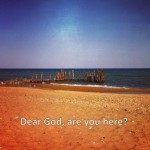
These original photos were taken at Lake Michigan on my iPhone 4 through the instagram app. I tweeted them with words of prayer, and this is how I prayed that day.

I put the slides with words into a PowerPoint slideshow, then turned that into a Quicktime movie and uploaded it to YouTube.

In the slideshow, the words fade in and out with special timings which you don’t see in the movie. It’s a bit choppy here, but gives you a way to watch it without downloading the whole PowerPoint slideshow.

If you *do* want to download it, there are links below to two different sizes. The quality of the slideshows is much better than the YouTube video.

Below, you will find the words to the prayer, which I made up while looking through my camera lens. It’s really much, much better with the photos. They are the center of the prayer.

Visual Prayer by Nanette Sawyer-8MB pptx file

Visual Prayer, by Nanette Sawyer-53 MB pptx file

Dear God, are you here?

I am listening.

The way does not seem straight.

I am worn down by the waves.

I am trying to see the patterns.

Everything changes all the time.

I can’t go back the same way.

Can’t go back.

Some of it looks familiar.

The waters are rising up to my neck.

Come to the aid of your people, Holy One.

Foundations of old have passed away.

The footing is uncertain.

Bit by bit I have been worn away.

From where does my help come?

Never have you forsaken me.

Answer me when I call.

You are my strength, from morning ’til night.

Lead me, O God.

Make a way out of no way.

Listen to your people.

You are our strength and our redeemer.

With you at my side, how can I be afraid?

In and through all things you guide me.

Creation is so big, and we are so small.

But we are inside it.

All of us are.

All of us.

All of us.

You have heard the prayers of your people, O God.

May your steadfast love endure forever.

May your steadfast love endure forever.

May your steadfast love endure forever.

Amen and Amen and Amen.

Joy ~ Consenting to Worthiness

This is the third week of Advent, and at Grace Commons we have a tradition of honoring Mary on this week. In the past we’ve used the theme of Courage and Action, contemplating how much courage it takes sometimes to move into action.

Mary, the mother of God, is such a great, courageous example for us. She steps into her destiny. That’s so courageous. She agrees to do something that won’t be easy or simple–but it’s right for her. She has the capacity to temporarily contain the uncontainable; to hold divinity within her body. And she chooses to do so!

This year we are using the more traditional weekly themes of Hope, Love, Joy (and next week, Peace.)

I’m thinking about the kind of steady, deep (different from cheery) joy that a person has when they are doing what they are meant to do–when they feel they are being useful in the world, and using their gifts well.

The Annunciation is the announcement of the angel telling Mary what is about to happen to her through her pregnancy. It seems it would be easier if God would announce as clearly what is to happen to each of us, but we are left to discern it, to seek out our vocations, our callings, our purposes, and our capacities.

Annunciation by Denise Levertov is one of my all-time favorite poems. You can read the full poem here.  Here’s a part of it:

Aren’t there annunciations
of one sort or another
in most lives?
Some unwillingly
undertake great destinies,
enact them in sullen pride,
uncomprehending.
More often
those moments
when roads of light and storm
open from darkness in a man or woman,
are turned away from
in dread, in a wave of weakness, in despair
and with relief.
Ordinary lives continue.
God does not smite them.
But the gates close, the pathway vanishes.

“Aren’t there annunciations of one sort or another in most lives?” We have that moment when we’re confronted with the opportunity to be authentic, to believe in ourselves, to tell the truth, to take a risk for love or justice, to do something for the ones who are looking to us, relying on us to use our gifts and skills and be strong, beautiful, compassionate, steady, protective, creative.

Some moments of potential we walk into. Other times we let the gates of possibility close because of our dread, our weakness, our despair. In those moments, not only does God not smite us, but God also does not abandon us. There is always a path before us, always a next step to take, and always God is near us, God-with-us, hoping we will have the courage to let go of our own sense of unworthiness.

It’s easy to think of the Virgin Mary as demure, as quiet and obedient, submissive–it’s easy, because we’ve been trained to think that way, about Mary, about the ideal woman, or the ideal Christian. Submit, obey, demure, sacrifice, deny yourself.

But I think Mary’s example and the teaching she offers us is exactly the opposite of that. To fulfill her destiny, she had to step into herself, embody herself, and realize her own capacity. By joining herself with God, she had the capacity to carry God within her and bring God into the world.

She did not cry, “I cannot, I am not worthy,”
nor “I have not the strength.”
She did not submit with gritted teeth,
raging, coerced.
Bravest of all humans,
consent illumined her.
The room filled with its light,
the lily glowed in it,
and the iridescent wings.
Consent,
courage unparalleled,
opened her utterly.

She was worthy. She was worthy to meet the task that was put before her. And so are you, and so am I.

Mary did not submit, but she gave consent. Think about the difference between those two words. To submit to coercion, or to consent to possibility. I love the idea that consent illumined her.

But to what was she consenting? What I love about this poem is that Mary consents to her own worthiness. She was worthy of being loved by God, “favored” the biblical text says. And I believe that God favors each and every one of us.

This is God’s omni-partiality (a word I got from Process Theologians); being partial to, or loving intensely and distinctly, every being. God waits for us to realize that God loves us. God waits for our consent to our own worthiness before we can be filled with luminosity.

But when we do consent to that worthiness, we are strengthened with courage. And, I would suggest, we open ourselves to the possibility of a deep and abiding joy.

~ ~ ~ ~ ~ ~ ~ ~ ~ ~ ~ ~ ~ ~ ~ ~ ~ ~ ~ ~

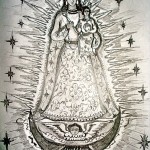
The image of the Spanish Our Lady of Guadalupe in Loboc, the Philippines, is from http://en.wikipedia.org/wiki/File:La_Guadalupana_Loboquena.jpg

Thankful

I am so impressed with this woman. She is making a pie a day for a year – one to give away every day to someone for whom she is thankful. What a wonderful practice. My friend, Adam Walker Cleveland is a pastor at her church and was the lucky recipient of pie #186.

I’m writing this post from the EconoLodge on my way to Tennessee where I will have three days with my family. I’ll be meeting my new nephew, Jennings, for the first time…for which I am so thankful!

I will also cook with my mom, walk in the woods, rock Kailee to sleep, work with my dad in his woodshop, sit in front of the fireplace, talk with my sisters, and visit with several wonderful nieces and nephews.

It is these simple things for which I am most grateful. Relationships, connections, cooking, eating, being in nature. And just being alive. Waking up in the mornings, still breathing.

While I won’t be making a pie every day, I am going to take a few minutes to just sit and think about all the things that I do have, and take a moment to be thankful for all of that. And to share that gratitude with others, I’m just going to show up and be.with. People can feel it when you love them.

What will you do to share your gratitude with the world?

A Life Well-Lived

I often speak about God’s dream for the world–that our world would become a place of shalom, meaning peace and wholeness and well-being. When I invite people to the communion table, for example, I often say that at the communion table we embody God’s dreams for a world where there will be no more tears, no hunger, no injustice.

The American Dream is something else. It suggests that we’re all responsible and capable of creating success for ourselves. And that success is defined largely in terms of wealth and the quantity of stuff, or the kinds of stuff, that we can acquire.

Dunham reminds us in her book that the drafters of the U. S. Constitution had in mind a democratic society with equality of opportunity, in which individual freedom would be balanced with the common good. (p3) That’s something we don’t talk about much–the common good, and how we all contribute to it.

Success is too often defined by money, power, and position, not by a life well lived.

So, what is a life well lived? I’m asking myself that. What would my life look like, if it was well lived?

I know that one of the things I struggle with is feeling that I have “enough”, or I have all I need, that I have the right things, and I don’t need more or different or better things. Sometimes I do need more, different or better things, but a lot of times, I don’t!

It’s so easy to use the language of “should” when talking about money and stuff. But I don’t find that “should” language helps me change very much. I think I need to better understand the roots of my feelings, in order to make conscious decisions and commitments, rather than being controlled under the table by my fears and whatever else I find in this process.

Dunham suggests seven “Graceful Living” concepts, and I’m going to attempt to work through them one at a time in upcoming posts. They are: abundance, frugality, simplicity, generosity, sustainability, justice, and Sabbath.

~ This is part of a series reflecting on Laura Dunham’s book, Graceful Living: Your Faith, Values, and Money in Changing Times. ~

Graceful Living: Faith, Values, and Money

In November I’m blogging this book by Laura Dunham, Graceful Living: Your Faith, Values, and Money in Changing Times. Laura is a Presbyterian minister, a certified financial planner, and a former college professor.

We’re taking a look at Stewardship at Wicker Park Grace, and how our relationship with money affects our relationships with the world and each other.

How is money a spiritual thing? How can getting our finances in order make us stronger spiritually?

Mostly I’ll focus on Part One in the book: Choosing How to Live.

Chapter One: Living in a Consumer Society

Chapter Two: Money as a Spiritual Concern

Chapter Three: Graceful Living: Designing a Lifestyle Consistent with Your Faith

I got a copy of this book from a Stewardship group at the Presbytery of Chicago, and unfortunately, I can’t find where it’s easily available on-line. If anybody knows, please post a comment here!

Becoming Bully Proof

Yesterday a good friend of mine was in a car accident (no one was injured), and the driver of the other vehicle leaped out of his car and called her a horrible string of names that can’t be repeated here.

Being in a car accident is a scary thing, for everyone involved. For a moment, you know that you are not in control. Human vulnerability is heightened. You could be injured. You could die. Things around you break. It’s scary.

But how do we respond? How do we respond to our human vulnerability? By attacking others? By flying into a rage? By becoming a bully? Will our bullying protect us from vulnerability?

And how then, do we respond to people who turn against us like bullies? This man became a bully. He attempted to prove his Powerful Nature by dominating my friend, by insulting and demeaning her. It was an act of violence, an act of hostility. It hurt her. It would hurt any of us.

Mahatma Gandhi said that when you feel humiliated by a bully, it’s a natural thing to want to slap them to “vindicate your self-respect.”* But instead of doing that, he suggested that we try to address the feeling of humiliation inside ourselves. He said that we could become “proof” against a bully’s insults. It’s a beautiful British use of the word “proof”–like a rain coat is rain proof, or a brick is fire proof.

I love the idea that we can become bully proof. But I know that it’s a life-long task! Gandhi talked about internalizing a non-violent spirit in order to become “proof” to violence.

I believe that bully-proofing begins with self-awareness of the shame and humiliation that is already inside us, learning to love and forgive ourselves again and again. For me, it has to do with accepting my imperfection and failings, and knowing that I am human and beautiful and beloved, even when I make terrible mistakes.

Usually, my mistakes are not as terrible as I fear, my imperfection is not as horrible as I dread. But that’s not the most important thing. The most important thing is extending generous hospitality to myself, even (especially) in the face of hostility directed against me.

Self-awareness and self-acceptance allow me to experience the goodness that is at the core of my being, underneath and before every bad judgement, every mistake, every oversight.

I make mistakes, but mistakes are not who I am. This awareness is the basis for feeling that I am completely capable of growing and changing–that I am valuable and deserve to be treated with respect at ALL times. All of us deserve to be recognized as having inherent worth and dignity.

Let a bully’s insults remain “in the bully’s mouth and not touch you at all,” Gandhi said.*


*You can find these quotes and more discussion of these ideas and related spiritual practices on page 139 in my book, in the chapter on “Hospitality to Enemies: Extending Generosity through Non-Retaliation.” The Gandhi quotes came originally from The Essential Gandhi: An Anthology of His Writings on His Life, Work, and Ideas, page 174. My book is Hospitality-The Sacred Art, published by Skylight Paths Publishing.

It’s All about Relationship

Every once in awhile, someone finds me on facebook to tell me what it was like to read my book. I love that and I’m so grateful that something I’ve created helps people.

Despite having “hospitality” as the title, the book is really about how to become a more loving, whole person.

One reader wrote that she found herself thinking more about relationships of all kinds after reading the book:

Just finished your book/loaned to me several months ago/ sat on the table with the stack of “to read”. Was not at all what I expected!

As the creator of several church “hospitality-outreach” programs… I expected a “How to make your church more inviting” manual.

Now that I have finished, I’m thinking more about me and my relationships, both large and small. Thank you so much for writing this book. I’m sure I will return to it often.

Writing the book helped me a lot, too. I felt like I got a lot more language for ideas that had only been vague ideas before struggling to write the book.

I love to write, but it’s hard to set aside the time! Writing this book was like being in Finals at school for a year, pretty much non-stop. Nevertheless, I do intend to write more books!

One obvious next book would be a Study Guide for Christians to go with my Hospitality-The Sacred Art. Because the book itself is written for a very broad audience, (people of various faiths or no faith), I would like to help Christians, or followers of Jesus if you prefer that language, to ground their practice of hospitality in Biblical scripture and Christian tradition.

Don’t Wait for a Gandhi

If you have a situation that seems endless and is a negative situation, don’t wait for a Gandhi, don’t wait for a King, don’t wait for a Mandela.

“You are your own Mandela; you are your own Gandhi; you are your own King. You know your issues; you know your concerns, and you know the solution.

Rise up and do something to change your situation around.”

(Liberian Lutheran Peace Activist Leymah Gbowee discusses her feelings on receiving the Nobel Peace Prize and the role faith played in her struggle to help end the war in Liberia.)

I referenced this in my reflection at Wicker Park Grace yesterday. Watch the 3 min video here, at Odyssey Network.

Life

I just found out that a dear friend has stage 3 cancer. I don’t even know what that means, except that she had surgery yesterday, and I was told by another friend to pray, pray, pray.(For privacy I am not putting her name, but she doesn’t live in Chicago.)

I used to live with her in a farmhouse in Hatfield, Massachusetts, and it just so happens that another friend, Ani, just emailed me a picture of sunset from her porch tonight in Hatfield, where Ani still lives.

The earth is such a beautiful place, filled with life. And life is impermanent.That is so scary, in part because of all we love and don’t want to lose.

I had a cancer scare myself a couple years ago. It didn’t turn out to be cancer, but it sure generated some serious thought about the nature of my life. Would I change it if I knew I had a very limited time to live? Usually I think I have another 40 or 50 years to live, and a person can get a lot done in 40 to 50 years. That feels so abundant! But what if I don’t have that long?

I want to say this out loud, (or write it down, as it were), that the big fear that rises up in me is that I would lose her, my friend. Of course that is the biggest and first fear. But that may not happen at all. It is entirely possible that she heal from this surgery and from this cancer. I know that many of my readers have also experienced cancer in your own bodies, or in the bodies of your loved ones. So this prayer is also for all of you and all those you love.

I imagine my friend strong and whole and healed, and pray for that, imagining life, and sodzo (healing, salvation, rescue, wholeness), and shalom (peace, well-being, completeness, safety.) This is my prayer.

I am going to do yoga now, and dedicate it to my friend’s sodzo and shalom. I know that we are each part of something so much larger than our-selves. And that large something is the wholeness of God. We cannot escape from it. We are safe in it. Embraced in the sunset pictured here. Embraced in the arms of God.

Catching the Light

When I look at your heavens, the work of your fingers,
the moon and the stars that you have established;
what are human beings that you are mindful of them,
mortals that you care for them?

Psalm 8:3-4

While I was on retreat in Maine this June, I did some experimenting with my camera. I aimed it toward the sky, which was filled with more stars than I ever see in Chicago. I tried to photograph them in the dark. I have a good camera, which I can manually control to hold open the aperture and expose the image for a long time.

The stars without the camera were incredible, but once I got the knack of photographing them, even more stars became visible. The camera allowed me to see further, and more deeply, than my bare eyes could.

Metaphorically, what are the lenses that help us to see more light? How long do we have to look, before the stars shine through?

Seeing these stars appear through the camera made me think about how much bigger than me everything is. My body, my eyes, (my mind) don’t have the capacity to stay open long enough to take in enough light to be able to see what is really there.

The psalm I included above asks, “what are human beings”, but the stars made me think, “what is God?” God, like the stars, is so far beyond my capacity to see.

Click on the image below to see more clearly the photo I took.